
If you’re in the food business in India, you don’t just need an FSSAI license—you also need to follow the rules and regulations laid down by the Food Safety and Standards Authority of India (FSSAI).
These rules are not optional. Violating them can lead to fines, license cancellation, or even criminal charges.
In this blog, we break down the core rules of FSSAI every food business operator (FBO) must follow, whether you’re a home baker or a nationwide restaurant chain.
What is FSSAI?
The Food Safety and Standards Authority of India (FSSAI) was established under the Food Safety and Standards Act, 2006. It governs the manufacture, storage, distribution, sale, and import of food to ensure that it is safe and healthy for human consumption.
Why Are FSSAI Rules Important?
FSSAI rules exist to:
- Protect consumers from unsafe or substandard food
- Standardize food labelling, hygiene, and safety
- Ensure transparency in the food industry
- Penalize adulteration, misbranding, or harmful practices
Top FSSAI Rules Every Business Must Follow
- Mandatory Licensing or Registration
Every food business must register or obtain a license from FSSAI, based on turnover and operation scale.
Penalty: Operating without an FSSAI license can attract fines up to ₹5 lakhs and business shutdown.
- Display of License Number
The 14-digit FSSAI license or registration number must be:
- Printed on packaged food products
- Displayed at business premises
- Included on invoices, receipts, and menus (if applicable)
Penalty: Fines of ₹2–5 lakh for failure to display.
- Hygiene and Sanitation Norms
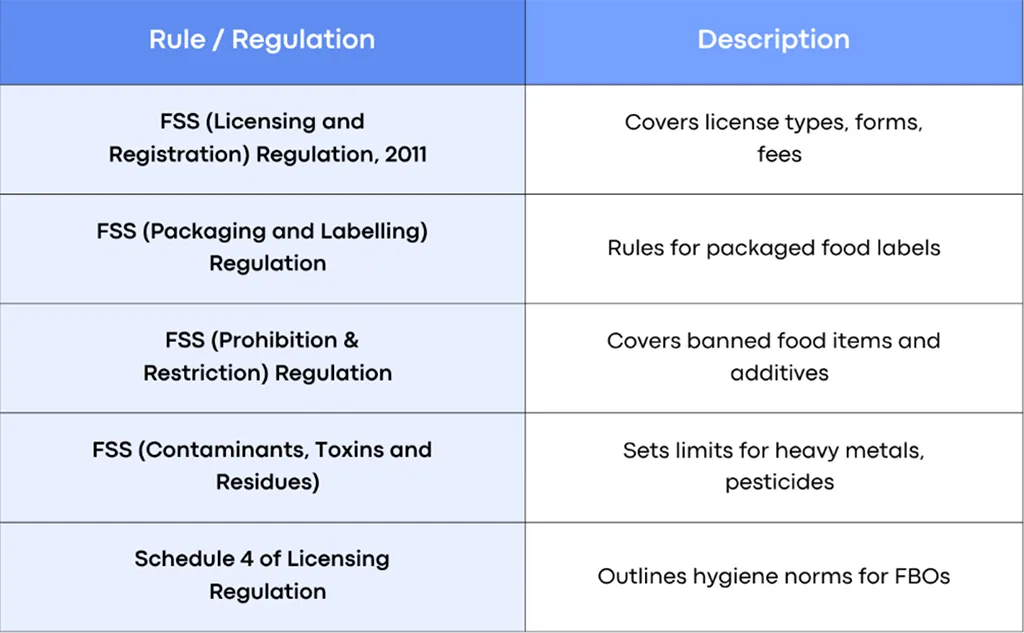
As per Schedule 4 of the FSSAI rules, all FBOs must maintain:
- Clean equipment and premises
- Proper handwashing and sanitation protocols
- Pest control and waste management
- Separate storage for raw and cooked food
Applies to: Restaurants, cloud kitchens, canteens, food factories, transporters
- Correct Labelling and Packaging
Every food label must include:
- Product name and FSSAI license number
- Ingredients and nutritional facts
- Veg/non-veg logo
- Expiry or best-before date
- Allergen warnings (if applicable)
- Manufacturer and batch number
Penalty: Misbranding or misleading labels can lead to fines and recalls.
- No Use of Banned Substances
The use of prohibited preservatives, artificial sweeteners, synthetic colours, or non-permitted ingredients is a criminal offense.FSSAI maintains a list of banned substances which must not be used under any circumstance.
- Food Safety Management System (FSMS)
Medium and large food businesses must implement and document an FSMS plan, including:
- Hazard analysis
- Critical control points
- Record-keeping of inspections and corrective actions
- Staff Training
FSSAI encourages all food handlers to undergo basic food safety training via FOSTAC (Food Safety Training and Certification).Many inspections ask for proof of training, especially in State/Central license audits.
- Storage and Transportation Compliance
- Maintain temperature-sensitive storage (cold chain, frozen, etc.)
- Prevent cross-contamination during transport
- Use clean, labelled containers
Applies to: Wholesalers, e-commerce sellers, FMCG brands, exporters
- Mandatory Renewal of License
Licenses and registrations are valid for 1–5 years (based on selection). They must be renewed 30 days before expiry.
Penalty: Operating with an expired license is considered the same as operating without one.
- Cooperation with Inspections
If your business is subject to a surprise inspection:
- You must allow access to inspectors
- Provide requested documents and samples
- Take corrective action within the timeline given
Key Sections from FSSAI Rules to Know
Conclusion
The FSSAI is the backbone of food safety regulation in India. Whether you’re a h
The FSSAI is not just about getting a license—it’s about maintaining ongoing compliance to protect your customers and business.
Following these rules ensures:
- Fewer audits and penalties
- Stronger consumer trust
- Long-term sustainability and brand value
(Need help getting licensed and staying 100% compliant? We offer end-to-end food license and audit support. Get started today →)ome cook, multinational brand, or online seller, FSSAI ensures the food you serve or sell is safe, standardized, and legally authorized.
Understanding and complying with FSSAI isn’t just a legal requirement—it’s good business.
(Want full support with your FSSAI license or compliance? We’ll handle it end-to-end. Apply now →)
FAQs
Is an FSSAI license mandatory even for a home-based food business?
Yes, registration is compulsory for all food sellers.
Do I need to print the license number on food packets?
Yes. It’s mandatory on all labels and bills.
What if I sell only raw fruits or vegetables?
You still need FSSAI registration if you sell for profit.
Is there a separate rule for restaurants vs manufacturers?
Yes. Manufacturers have stricter hygiene and FSMS rules.
Can I be fined for using tap water?
Only if it fails to meet water quality standards or lacks proper testing.
How often are inspections conducted?
Randomly or based on consumer complaints or audit schedules.
What happens during an FSSAI inspection?
They may check hygiene, records, product labels, and sample food.
Can I change my license category later?
Yes, through modification or renewal via the FoSCoS portal.
What if I miss renewing my license?
Your license lapses, and you must reapply from scratch.
Is food safety training mandatory?
Highly recommended and sometimes required, especially under State/Central licenses.